16. Januar 2026
Proactive Support Alerts for Hotels: Prevent Check-In Day Problems
Proactive support alerts for hotels help detect access, registration, and system issues before guests arrive, preventing check-in day problems.
JobelHome
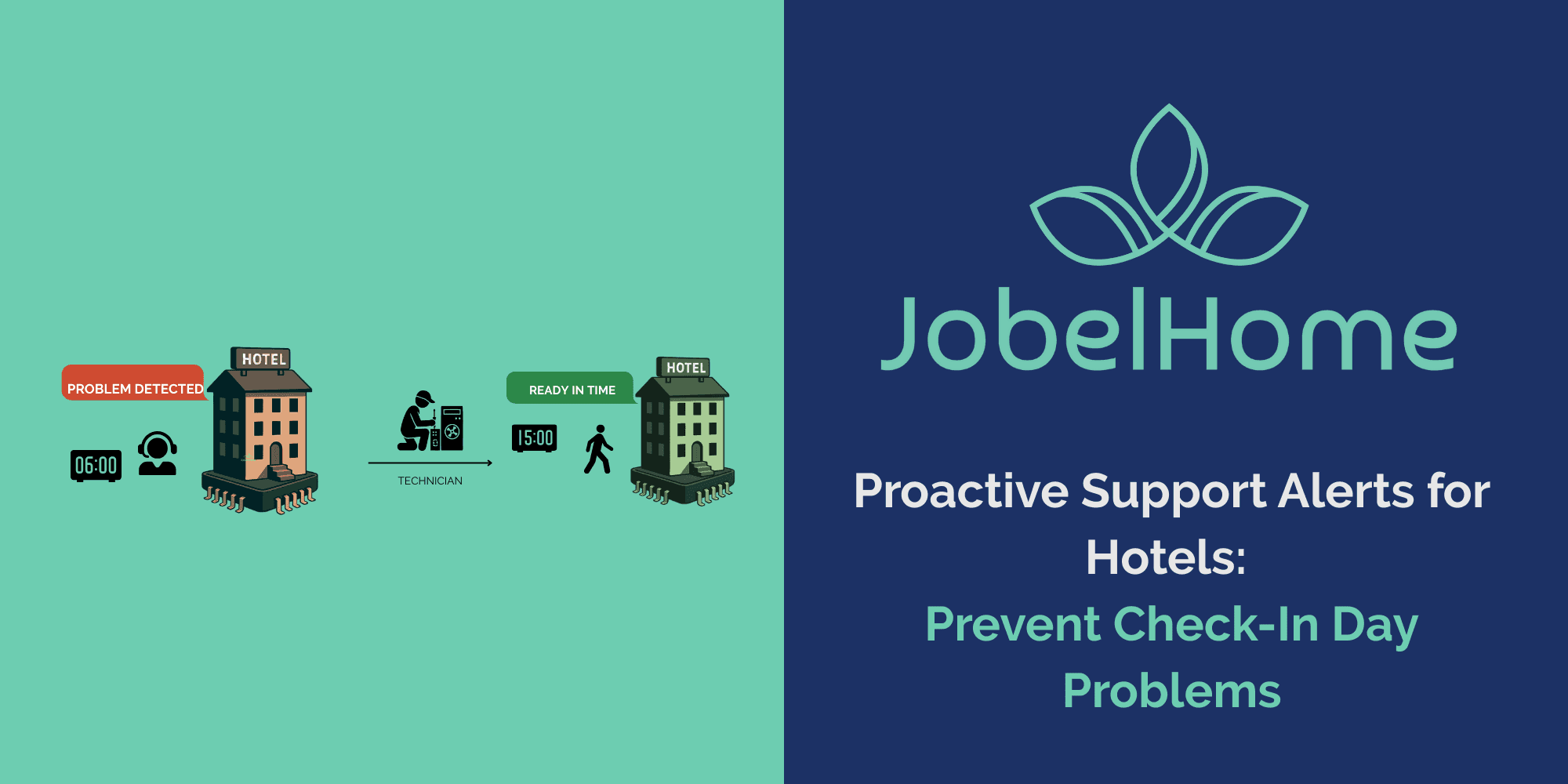
How Proactive Support Alerts Prevent Problems on Check-In Day
Proactive support alerts for hotels play a critical role on check-in day, when guest expectations are highest and operational pressure peaks. Most guest frustrations do not come from major failures. They come from small issues that surface at the worst possible moment: arrival.
Check-in day concentrates multiple risks into a short time window. Access must work. Rooms must be ready. Systems must respond correctly. When something goes wrong, there is very little time to recover calmly.
This is why proactive alerting matters most before and during check-in.
Why check-in day is operationally fragile
Check-in day is when operational dependencies collide.
Hotels and serviced apartments often deal with:
Tight turnover between guests
Late housekeeping or maintenance delays
Guests arriving outside standard reception hours
Access systems being activated just in time
Smart systems switching from standby to active use
When everything works, the guest never notices the complexity behind it. When something fails, it becomes immediately visible.
Reactive support on check-in day usually means solving problems under pressure, while the guest is already waiting.
Problems usually appear before the guest arrives
Most check-in issues do not start at the door.
They often begin earlier:
Access credentials fail to activate on time
A registration step is incomplete
A device does not respond during system handover
A room state does not update correctly after checkout
A dependency between booking and operations breaks
Without early visibility, these issues remain hidden until the guest encounters them directly.
By then, the experience is already compromised.
This follows the same pattern seen in other guest experience escalations:
https://www.jobelhome.com/blog/why-guest-complaints-usually-start-long-before-the-guest-speaks-up
What proactive support alerts actually change
Proactive support alerts for hotels surface potential problems before guests are affected.
Instead of waiting for:
A guest call
A message at the door
A negative first impression
Operators receive alerts when something deviates from expected operational flow.
This allows teams to:
Fix issues before arrival
Reach out proactively if needed
Resolve problems without urgency
Prevent frustration altogether
The key shift is timing. Alerts arrive when action is still easy, not when it is already emotional.
Examples of proactive alerts on check-in day
Proactive alerting can cover multiple risk points, such as:
Missing or incomplete guest registration
Access not activated within the expected timeframe
System states not matching booking status
Failed device responses
Unusual delays during room preparation
Each alert represents an opportunity to intervene quietly, without involving the guest at all.
This is especially important in contactless or hybrid operations, where there is no physical front desk buffer.
How proactive alerts improve guest perception
From the guest’s perspective, proactive support feels invisible.
They experience:
Smooth arrival
Immediate access
Clear instructions
No need to ask for help
They do not see alerts, dashboards, or interventions. They only see that things work.
This has a direct impact on:
First impressions
Review sentiment
Perceived professionalism
Trust in the property
Prevented problems do not generate praise, but they quietly protect reputation.
Scaling check-in reliability across properties
As hotel portfolios grow, manual oversight on check-in day becomes unrealistic.
More rooms mean:
More bookings
More dependencies
More potential failure points
Proactive support alerts scale without increasing staff load. Once alert logic is defined, it applies consistently across all properties and check-ins.
This allows operators to maintain a reliable arrival experience even as operations expand.
To see how this works in practice, explore JobelHome’s support alerts system:
https://www.jobelhome.com/support-alerts
From reactive support to operational confidence
Without proactive alerts, support teams operate in reactive mode.
With them, operations become predictable:
Fewer emergency calls
Less guest-facing friction
Calmer staff workflows
Clear ownership of issues
Check-in day shifts from a risk-heavy moment to a controlled process.
This mirrors the broader operational principle that visibility prevents escalation:
https://www.jobelhome.com/blog/how-early-noise-alerts-prevent-police-and-neighbour-escalations
Conclusion: check-in problems are preventable
Check-in issues are not inevitable. They are usually the result of missing early signals.
Proactive support alerts for hotels give teams the visibility they need to act before guests are affected. By detecting operational deviations early and responding calmly, hotels protect first impressions, reduce support pressure, and deliver a smoother arrival experience.
The best check-in is the one where nothing needs to be explained.
To understand how proactive alerting fits into modern hospitality operations, explore JobelHome’s support alerts system:
https://www.jobelhome.com/support-alerts
Who We Are
JobelHome is a hospitality automation platform helping hotels and holiday homes reduce operational effort, energy waste, and guest friction through smart, connected systems.
Website: https://www.jobelhome.com/
Instagram: https://www.instagram.com/jobelhomeplatform/
LinkedIn: https://www.linkedin.com/company/105750936/admin/dashboard/
Email: hello@jobelhome.com